Interactive 3D Models: More Than Just Visuals
- Richie Romero
- May 4
- 7 min read
Interactive 3D Models: More Than Just Visuals
The fastest way to waste money on 3D is to treat it like a prettier photo gallery. Interactive 3D models only pay off when they change decisions: fewer site visits, fewer rework loops, faster approvals, and fewer “we didn’t see that coming” moments in operations. That’s the line between a cool experience and a working system.
TL;DR
Interactive 3D models create business value when they reduce uncertainty: stakeholders can verify dimensions, context, and constraints instead of guessing from 2D plans or stitched panoramas.
Digital twins go beyond visuals by supporting operational use cases (asset location, safety planning, training, collaboration) inside a spatially accurate model.
McKinsey reports digital twins can improve operational efficiency by 10–15% when tied to real workflows and data.
If you want ROI, start with capture fidelity, then add collaboration + measurement (hotspots, notes, analytics) so the model actually drives action.
Related Video
Video: AI-Accelerated Product Material Exploration in 3D by VECTARY
What interactive 3D models actually change in decision-making
Interactive 3D models let a stakeholder move through a space, check sightlines, validate adjacency, and understand scale without waiting for a site walk or another revision round. That interactivity turns “I think this works” into “I can see it works.”
What most teams misunderstand: they judge 3D by visual realism alone. Realism helps, but decision utility is what pays—navigation, measurement, and the ability to anchor information to a specific location. Miss that, and the model becomes a marketing asset that operations ignores.

That’s where most rollouts break. The model looks great, but nobody uses it to decide anything.
If your goal is operational clarity (not just a wow moment), start with a spatially accurate foundation like a 3D Digital Twin built with Gaussian Splatting. Then build the “decision layer” on top:
Capture for accuracy first: prioritize true scale and continuity of movement so teams trust what they’re seeing.
Add location-based context: use Interactive Hotspots-style placement (spec sheets, SOPs, videos) where decisions happen.
Make collaboration unavoidable: use Pinned Notes for Collaboration so issues and tasks live at the exact physical location—no more “which panel are we talking about?” threads.
Digital twin ROI: the only three levers that matter
Digital twin ROI doesn’t come from “having a twin.” It comes from pulling three levers: time saved, errors avoided, and decisions accelerated. When a model replaces even a portion of site visits, reduces rework, or prevents downtime, the math gets real fast.
What most digital twin initiatives get wrong: they stop at a model and never connect it to an operating cadence—maintenance routines, safety audits, training, or capital planning. A twin without a workflow is a museum exhibit.
This isn’t a feature — it’s the problem.
Use these practical applications to tie the model to measurable outcomes:
Facilities & asset clarity: a current 3D record reduces “where is it?” time and eliminates reliance on outdated floor plans. Verge Visions supports this through Digital Twin Solutions for Facilities, Data Centers & Industrial Sites and Facility Management outcomes.
Safety planning and response: build pre-incident familiarity with Safety Response & Evacuation workflows and Critical Incident Mapping so teams coordinate using the same spatial truth.
Training without disruption: run scenario-based walkthroughs using Training & Simulation instead of scheduling full-scale live drills that stall operations.
Adoption is accelerating because organizations want fewer surprises. Gartner’s digital twin coverage tracks rapid enterprise uptake as IoT and operational analytics mature, and IBM’s digital twin overview outlines why twins become more valuable when linked to data and processes—not just visualization.
To measure ROI without hand-waving, run a 90-day baseline-to-impact loop:
Pick one high-cost friction point: site visits, safety audits, maintenance triage, or sales qualification.
Define 2–3 metrics: travel hours avoided, time-to-approval, number of rework cycles, mean time to locate an asset, training completion time.
Instrument usage: use Real-Time Analytics to see which zones get attention and which hotspots drive action.
Review monthly: if the model isn’t changing behavior, fix the workflow—not the camera.
Immersive storytelling that shortens sales cycles (when done correctly)
Interactive 3D models outperform static galleries when they remove a buyer’s uncertainty: layout, finishes, flow, and context become self-serve. That’s why immersive experiences tend to increase confidence—especially for high-consideration purchases where “I need to see it” blocks the deal.
Here’s where this breaks down: many “virtual tour” experiences show a space but don’t guide decisions. No narrative, no proof points, no next step—just wandering. Buyers don’t need more freedom; they need fewer unanswered questions.
Verge Visions builds photorealistic, navigable experiences through Resorts & Destinations and Residential Virtual Tour engagements, where “Your Showroom, Open 24/7. From Anywhere.” is operationally true: the experience is always accessible, embeddable, and shareable.
For the behavioral side, Harvard Business Review details how immersive media can increase empathy and user confidence—useful framing for why interactive experiences reduce hesitation when a buyer can’t visit in person.
Use this three-step build for immersive storytelling that converts:
Map the buyer’s “proof sequence”: what must they believe before they book, request pricing, or schedule a visit?
Place proof in-space: add Interactive Hotspots for specs, amenity details, warranty docs, or comparison points exactly where the question arises.
Enable guided selling: use Live Guided Tours so a rep can walk a prospect through the space in real time—no app, no friction.
Case study: Porsche’s interactive 3D showroom—what made it work
Porsche’s use of an interactive 3D showroom illustrates the difference between “3D content” and a sales tool. In Verge Visions’ Porsche 3D Showroom, the experience is designed for product exploration and guided selling: prospects can move through the environment, focus on details, and access embedded information without bouncing between tabs.
The mechanism is the win: fewer context switches, clearer product understanding, and a tighter handoff to sales. That’s what increases conversion—not novelty.
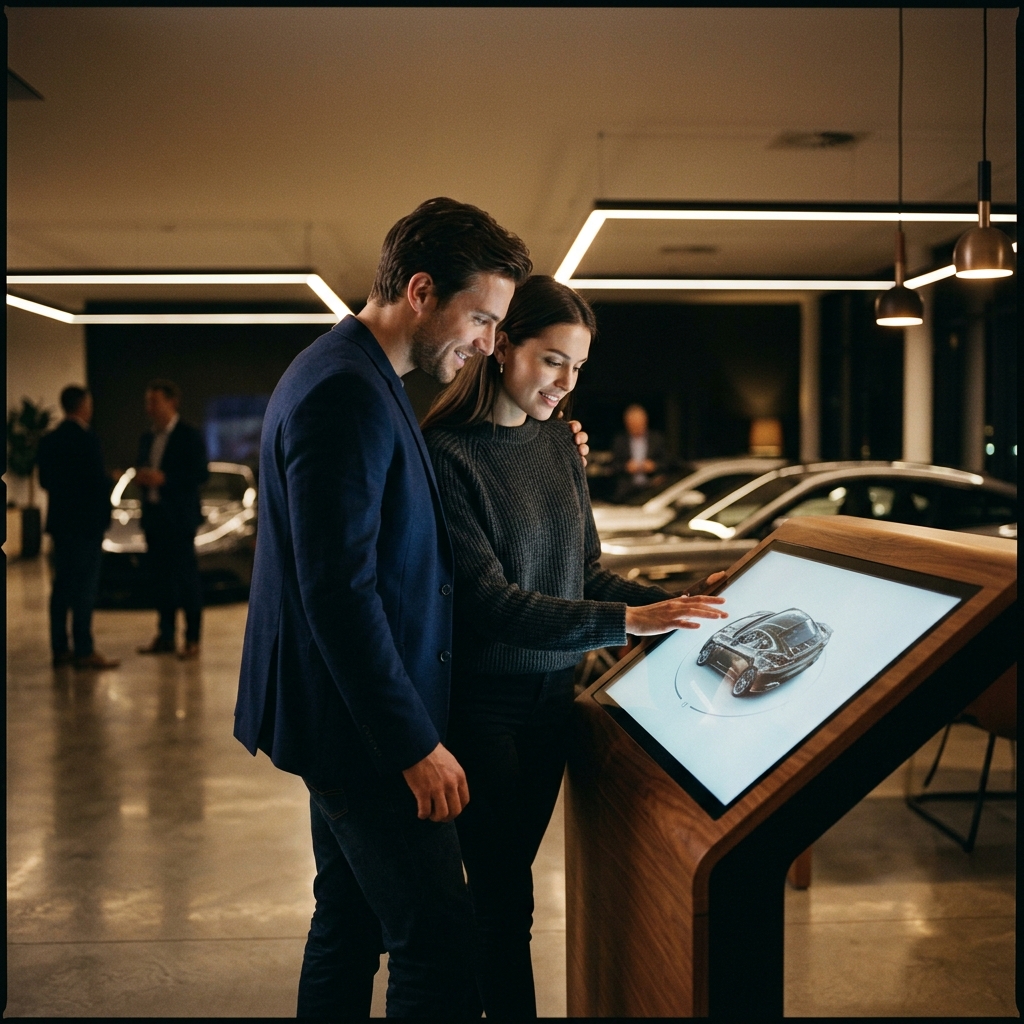
Industry research supports the direction of travel. Deloitte’s digital twin coverage outlines how digital twin approaches in manufacturing and product ecosystems improve visibility and engagement when connected to real processes.
If you’re building a similar experience, don’t start by asking “How realistic can we make it?” Start here:
What questions stop a buyer from moving forward? Put those answers into the space.
What needs a human? Use guided tours for the moments that require trust-building.
What gets measured? Track engagement patterns so the experience improves instead of stagnating.
For teams evaluating platforms, Verge Visions also breaks down tradeoffs in Matterport Alternatives—useful if you’re comparing capture approaches and long-term operational flexibility.
Expert view: digital twins aren’t replicas—they’re prediction engines
Dr. Michael Grieves, widely credited with originating the digital twin concept, has consistently emphasized that the twin’s value is not replication alone but the ability to improve decisions over time. The point is optimization: the model becomes a place where data, context, and action meet. That’s the shift most teams miss.
Pretty twins get shared. Operational twins get used.
At Verge Visions, that’s why digital twins are packaged with features that drive action inside the environment—training, safety planning, and collaboration—rather than treating the deliverable as a one-time visual artifact. If you want a deeper walkthrough of how organizations apply twins beyond visualization, see Exploring the Transformative Potential of Digital Twin Applications and Harnessing Efficiency Through Digital Twin Creation.
To move from concept to deployment, use this rollout sequence:
Choose one workflow: safety audits, maintenance triage, training onboarding, or remote qualification.
Build the twin once: capture the space at a fidelity that teams trust for real decisions.
Embed the operating system: hotspots, pinned notes, and guided tours so the twin becomes where work happens.
Prove adoption with analytics: if engagement stays flat, you don’t have a tech issue—you have a process issue.
How to decide: interactive 3D model vs. digital twin vs. virtual tour
If you’re choosing a solution, the label matters less than the outcome. Use this quick decision filter:
Choose a 3D Virtual Tour when the goal is marketing and remote walkthroughs (hospitality, leasing, destinations). Verge Visions offers full-service capture via 3D Virtual Tour.
Choose a 3D Digital Twin when operations, safety, training, or facilities management need spatial truth and repeatable workflows. Start here: 3D Digital Twins & Immersive Simulation Training.
Choose 3D Drone Aerial Mapping when exterior conditions, grounds, or surrounding infrastructure drive decisions (campuses, golf courses, construction exteriors). Example deliverables include Drone 3D Mapping School Stadium and Austin Country Club 3D Drone Mapping & Photography.
Choose wrong here, and you don’t just buy the wrong deliverable—you lock teams into the wrong workflow.
FAQ
What makes interactive 3D models different from traditional visuals?
Interactive 3D models let users navigate, inspect, and understand scale and context inside the environment. Traditional visuals are static; interactivity supports verification, collaboration, and—when designed correctly—repeatable workflows.
How do I measure digital twin ROI without guessing?
Pick one workflow (maintenance triage, safety audits, training onboarding, or sales qualification), define 2–3 metrics (hours saved, rework cycles reduced, downtime avoided), and track adoption with usage data such as Real-Time Analytics.
Are interactive 3D models suitable for safety training?
Yes—when the model is spatially accurate and built for scenarios. Verge Visions supports this with Training & Simulation and Critical Incident Mapping so teams can rehearse procedures in the real building layout without disrupting operations.
What’s the fastest way to start immersive storytelling that actually converts?
Start with a photorealistic capture, then place answers where questions occur: use Interactive Hotspots for specs, videos, and proof points, and add Live Guided Tours for high-intent prospects who need a human walkthrough.
Schedule the model that people actually use
If your interactive 3D model doesn’t reduce site visits, prevent mistakes, or accelerate approvals, it’s not a business tool—it’s a screenshot generator. Verge Visions builds photorealistic, immersive digital twins with Gaussian Splatting so teams can operate from spatial truth. Explore Verge Visions projects and insights or find the right solution area, then schedule a free consultation to scope a capture that ties directly to measurable outcomes.
About the Author
Naomi Keller is a strategist in content and visual media at Verge Visions, specializing in performance-driven storytelling and VR/AR-informed buyer experiences. She helps teams turn photorealistic 3D capture into measurable outcomes—shorter sales cycles, clearer operational decisions, and training that doesn’t disrupt the workday.