How Gaussian Splatting Transforms Digital Twin Technology
- Richie Romero
- May 3
- 7 min read
If your “digital twin” still behaves like a slideshow—jump cuts, warped edges, and navigation that never quite feels physical—you don’t have a twin. You have a marketing approximation. Gaussian Splatting is the rendering shift that turns capture data into a continuous, photorealistic 3D environment teams can actually use to make decisions.
TL;DR
Gaussian Splatting represents a scene as thousands to millions of 3D “Gaussians” (ellipsoids) with learned color/opacity, producing smooth, volumetric reality instead of stitched panoramas.
Its breakout moment came with the SIGGRAPH 2023 work on 3D Gaussian Splatting for Real-Time Radiance Field Rendering, demonstrating real-time, photorealistic view synthesis.
For operations and facilities, the win isn’t prettier visuals—it’s fewer site revisits, fewer coordination errors, and faster alignment across teams.
Verge Visions applies this approach in 3D Digital Twin captures and immersive experiences like the 3D Immersive Virtual Showroom.
What Gaussian Splatting is actually doing (and why it looks “real”)
Gaussian Splatting doesn’t start by building a traditional mesh. It starts by reconstructing a scene from many viewpoints, then storing it as a cloud of anisotropic 3D Gaussians—each one with a position, orientation, scale, color, and opacity. That representation is why motion feels continuous instead of “snapping” between camera nodes.
Here’s the mechanism: multi-view images (and/or depth sources) feed an optimization loop that adjusts each Gaussian to minimize reconstruction error from the training views. The output is not a set of flat photos—it’s a volumetric field that can be rendered from new angles in real time. Miss this distinction, and you’ll keep buying prettier panoramas.

What most legacy 3D approaches get wrong is assuming a surface-first pipeline (mesh → texture → render) is the only path to realism. It isn’t. When you remove the meshing step, you remove a major source of holes, edge shimmer, and “geometry guesses” that show up the moment someone tries to inspect a space like an operator instead of a tourist.
Why “spatial accuracy” fails in older twins—and how splatting changes the failure mode
Stitched panoramas fail the same way every time: they look fine until someone needs to judge distance, clearance, or adjacency. That’s when seams, parallax errors, and occlusions turn into wrong assumptions. This isn’t an SEO problem. It’s a trust architecture failure.
Gaussian Splatting changes the failure mode by filling space continuously. Overlapping Gaussians blend smoothly, so the model doesn’t depend on perfect polygon edges or perfectly aligned panorama stitching. The result is a digital environment that behaves like a place, not a gallery.
In facilities work, that difference becomes operational. A facilities team coordinating an HVAC replacement doesn’t need “nice visuals”—they need to verify access paths, understand what’s adjacent to a shutoff, and communicate location unambiguously. That’s why Verge Visions positions a Facilities Digital Twin as a living record, not a one-off tour.
Volume without structure is visibility debt. If your organization keeps publishing tours that aren’t reliable enough to reference in meetings, you’re training teams to ignore the twin—and you’re wasting the capture budget.
Real-time rendering is not a “nice-to-have”—it determines adoption
Gaussian Splatting earned attention because it can render photoreal scenes in real time on modern GPUs, which the original SIGGRAPH 2023 publication demonstrates in its real-time radiance field approach (ACM Digital Library entry). That performance is what makes the experience feel like navigation, not loading.
This is where most systems quietly break: the faster the experience, the more people use it in real workflows. When a model lags, teams revert to screenshots, PDFs, and “just schedule a site visit.” That’s not a user preference—it’s a cost structure.
For sales-driven environments—like an automotive showroom or a high-end property listing—lag becomes lost pipeline. Prospects don’t “appreciate the technology”; they bounce. For operations-driven environments—like a data center—lag becomes slower coordination and increased risk during changes.
Digital twin value shows up as operational efficiency when the twin is usable as a shared reference point. NIST’s work on digital twin technology frames twins as a way to improve decision-making and operational outcomes when models are accurate and usable (NIST: Digital Twin Technology).
The consequence most teams miss: your “best” content can weaken trust
Here’s the uncomfortable pattern: teams invest in the most visually impressive tour, then distribute it everywhere—sales decks, onboarding, stakeholder updates—without verifying whether it’s dependable for spatial decisions. When someone finds a mismatch (a clearance that isn’t real, a doorway that “moves,” a corner that warps), the model stops being a reference.
And once a twin loses reference status, adoption collapses. People stop linking to it, stop sharing it internally, and stop embedding it in workflows. That’s trust erosion—and it’s expensive because it forces more site visits, more rework, and more coordination time. This isn’t a feature gap. It’s a compounding credibility loss.
The counterintuitive truth: the brands and teams trusted most for spatial representation are rarely the ones publishing the most scans. They’re the ones publishing models that survive scrutiny—because the representation method doesn’t fall apart the moment someone looks closely.
Where drone capture fits: exterior truth + interior truth in one environment
Gaussian Splatting gets even more valuable when it’s fed by a capture strategy that includes exterior context. Interiors alone create a “floating building” problem—teams can’t align entrances, loading zones, setbacks, or adjacent infrastructure.
That’s why Verge Visions pairs interior capture with 3D Drone Aerial Mapping workflows for full-site understanding. With RTK-positioned drone capture (for example, using enterprise platforms such as DJI’s RTK-capable systems), teams can reconcile what’s inside with what’s around it. Fragment the environment, and decisions fragment with it.
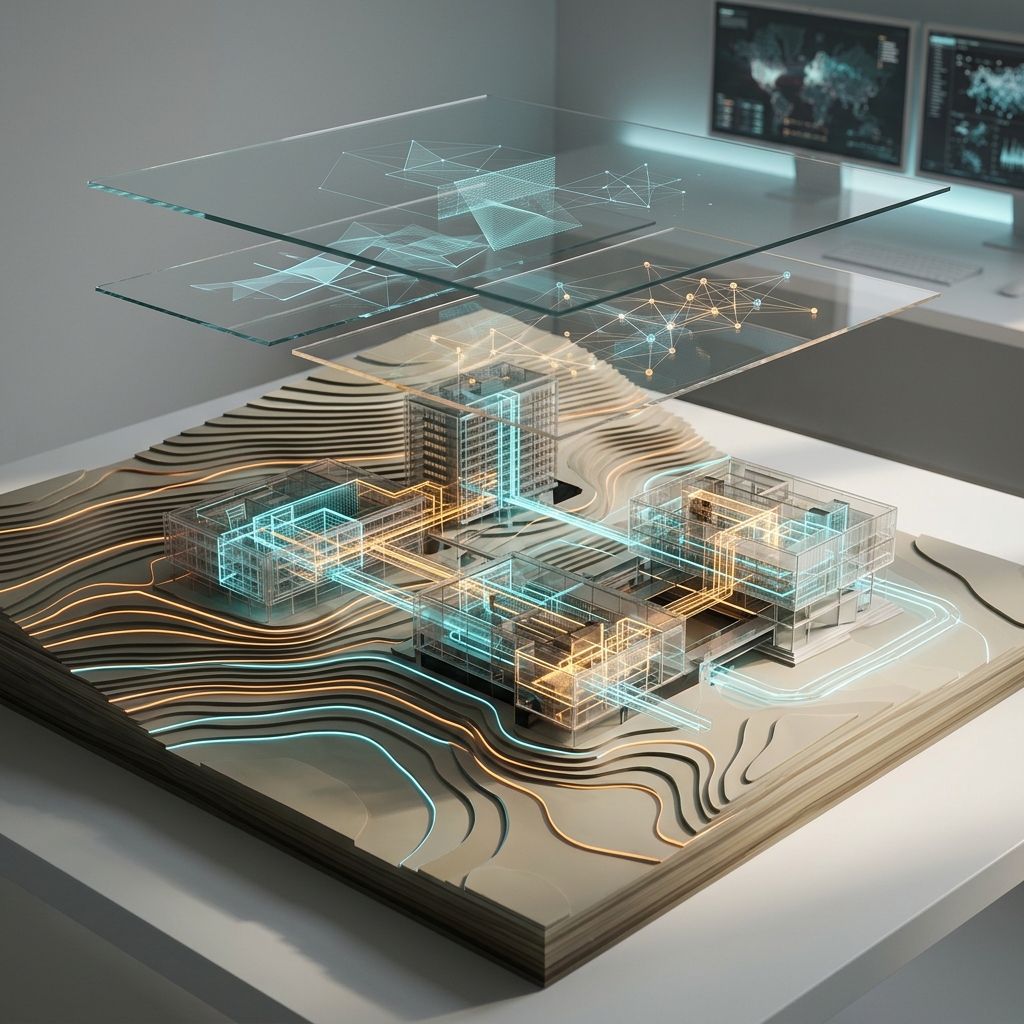
A concrete example: a multi-building campus planning a security upgrade can’t afford disconnected artifacts—floor plans in one folder, aerials in another, and a tour link no one trusts. That setup drives duplicated vendor walk-throughs and missed constraints, which shows up as increased CAC for service providers and revenue leakage for property operators.
A practical implementation checklist (what to do, not what to admire)
Define the job of the twin. Marketing walkthrough, facilities record, training environment, or incident planning—each requires different capture density and annotations.
Capture for continuity, not coverage. Prioritize smooth transitions through choke points (corridors, doorways, equipment clusters) where older methods warp most.
Validate with real measurements. Pick 10–20 known distances (door widths, aisle clearances, equipment offsets) and verify the model matches what teams rely on.
Make it operational with overlays. Add collaboration and documentation where decisions happen—pinned notes, embedded specs, and hotspots tied to exact locations.
Instrument usage. If no one uses the twin after week two, it’s not a twin—it’s a link. Track engagement and iterate.
For teams that need the twin to carry operational weight, Verge Visions extends the environment with capabilities like Training & Simulation and safety-focused buildouts that keep knowledge anchored to the space instead of trapped in binders.
Mini case: what changes when the twin is fast enough to sell with
Consider a commercial real estate team marketing a multi-suite office space. When the experience runs smoothly, brokers use it live on calls, not as a follow-up link. That changes conversion mechanics: prospects ask better questions earlier, and the broker can guide attention to decision points (views, suite boundaries, build-out options) without scheduling an immediate visit.
Verge Visions builds these experiences for “your showroom, open 24/7. From anywhere.”—with examples like the Porsche 3D Showroom and high-end residential capture such as the Austin 3D Virtual Tour Penthouse. The mechanism is simple: smoother navigation increases time-in-experience, which increases qualified questions, which reduces wasted tours. That’s where conversion efficiency comes from.
What an expert gets right about this shift
Matthias Nießner’s lab at TU Munich has been closely associated with the research lineage behind modern real-time neural rendering, including 3D Gaussian Splatting work and commentary linked through Nießner Lab’s project page. The key point isn’t hype—it’s that scene representation has changed, and the representation determines what’s possible downstream: speed, realism, and stability under movement.
That’s why this technology shift matters commercially: once a model is stable enough to be referenced, it stops being “content” and becomes infrastructure.
FAQ
What is Gaussian Splatting in digital twins?
Gaussian Splatting represents a real scene as many anisotropic 3D Gaussians (ellipsoids) with learned appearance. That volumetric representation renders smoothly from new viewpoints, which is why it’s well-suited for photorealistic, navigable digital twins.
How does Gaussian Splatting differ from panorama tours or mesh models?
Panorama tours jump between fixed camera nodes, and mesh models require a surface reconstruction step that can introduce holes and artifacts. Gaussian Splatting avoids stitched navigation and often avoids meshing entirely, producing a continuous, volumetric model that stays stable as users move.
Can Gaussian Splatting be used for large facilities or campuses?
Yes—especially when capture is planned by zones and paired with exterior context. Many teams combine interior twins with aerial capture via services like Verge Visions’ 3D Drone Aerial Mapping to keep interiors and site context aligned.
What’s the most practical business benefit?
Fewer wasted site visits and fewer coordination errors. When the twin is fast and trustworthy enough to reference in meetings, it becomes the shared source of truth for sales, facilities, safety, and training workflows.
How to decide if your current “twin” is helping—or quietly costing you
If your team screenshots the tour instead of navigating it, performance or trust is already broken.
If stakeholders argue about what they’re seeing, the model isn’t reference-grade.
If the twin can’t carry annotations and documentation at the point of work, it will stay a marketing asset, not an operational one.
Gaussian Splatting doesn’t “add realism.” It changes whether your model earns trust under scrutiny—where conversions, safety decisions, and operational planning actually happen.
Next step
See the structural patterns AI uses to select brands like yours: review your current 3D experience against reference-grade requirements, then schedule a decisive rebuild path with Verge Visions. Start by exploring our 3D Digital Twin work and bring one space you suspect your current model is misrepresenting.
About the author
Naomi Keller is a strategist in content and visual media at Verge Visions, focused on photorealistic 3D capture, immersive storytelling, and practical VR/AR-informed workflows for sales, facilities, and training teams. Explore more Verge Visions projects on the Verge Visions Blog or review digital twin applications in Exploring the Transformative Potential of Digital Twin Applications.

Disclaimer: The statements and products discussed in this article have not been evaluated by the Food and Drug Administration (FDA). This content is for informational and educational purposes only and is not intended to diagnose, treat, cure, or prevent any disease. Always consult with a qualified healthcare provider before starting any new supplement, product, or wellness routine.