Beyond Aesthetics: The Operational Power of 3D Virtual Tours
- Richie Romero
- May 11
- 7 min read
A 3D virtual tour fails the moment your team treats it like a prettier photo gallery. In real operations—data centers, resorts, campuses, showrooms—what matters is whether a remote person can make a correct decision fast, with zero ambiguity, while the site keeps moving.
TL;DR
A 3D virtual tour becomes operational when it’s spatially reliable, navigable, and built to carry decisions—not just impressions.
Digital twin programs are tied to measurable performance gains; Deloitte reports organizations use digital twins to improve performance and reduce downtime in Industry 4.0 environments (Deloitte: Digital twin technology in smart factories).
Verge Visions captures spaces with Gaussian Splatting to produce photorealistic, continuous movement and true spatial depth—useful for facilities, safety, training, and sales.
The shift is simple: stop “showing the space” and start “running the space.”
What actually turns a “tour” into an operational system
A tour becomes operational the minute it can answer three questions on demand: Where is it?What is it?What happens if we touch it? That requires a model with dependable spatial cues, not a stitched set of panoramas that only looks right from a few camera points.
This is where many teams misread the problem. They assume the win is visual polish. The win is decision latency—how quickly someone can move from “something’s wrong” to “here’s the exact asset, in the exact location, with the exact context.” Miss that, and your “tour” becomes a marketing artifact that operations quietly ignores.

This isn’t an SEO problem. It’s an identity problem: are you building content, or building a usable representation of reality?
Spatial capture: why Gaussian Splatting changes the reliability of what you see
Here’s the mechanism: capture creates the raw visual field; reconstruction turns it into a navigable environment; navigation determines whether humans trust it. Gaussian Splatting matters because it produces continuous, natural movement and true spatial depth, which eliminates the “teleport” feeling that makes people second-guess what they’re seeing.
Verge Visions uses this approach in its 3D Digital Twin work: a spatially accurate 3D replica built to support decisions teams can trust—without shutting down the site to capture it. That “no disruption” constraint is operational, not aesthetic.
In practice, this is why a facilities lead can brief a vendor remotely, a safety officer can validate an egress route, and a GM can walk a new manager through a property—without pretending a PDF floor plan is “good enough.” Static plans don’t fail loudly. They fail slowly.
Tagging is the bridge between “seeing” and “acting”
A virtual environment becomes useful the moment it carries meaning at the point of view. That’s what spatial tagging does: it binds knowledge to a location so the next person doesn’t have to rediscover it.
With Verge Visions, teams operationalize this through platform features like Interactive Hotspots (embed documents, videos, links, and instructions exactly where they’re needed) and Pinned Notes for Collaboration (drop tasks and findings in the space itself). That’s why the same capture supports maintenance, onboarding, inspections, and stakeholder approvals. One model. Multiple departments. Real ROI.
Short version: if the knowledge isn’t anchored in the space, it leaks back into email threads and binders. That’s where most systems break.
Real-time inputs: when a “tour” starts behaving like a dashboard
The operational leap happens when the model becomes a place your team works, not just a place they visit. Connect a 3D environment to live context—IoT readings, inspection status, asset documentation—and the space turns into a decision interface.
Even without full sensor integration, the same effect shows up through structured asset location and audit readiness. Verge Visions’ Safety Object Identification makes critical safety assets (AEDs, fire suppression, utility shutoffs, hazmat zones) instantly findable because they’re tagged where they physically exist. No scrolling. No “I think it’s on the north wall.” Just location truth.
A facilities team that can’t locate assets quickly doesn’t just lose time—it loses credibility during audits and incident response. Trust erosion is expensive.
Here’s the consequence nobody budgets for: your “pretty tour” can increase CAC
If your 3D virtual tour is built as a visual novelty, it creates a quiet failure pattern: it attracts attention but doesn’t convert certainty. Prospects still request site visits. Buyers still hesitate. Ops still asks for measurements “just to be safe.” So you pay for the tour and keep paying the old costs—travel, delays, coordination, and back-and-forth.
That’s not a feature—it’s the problem.
In commercial real estate and hospitality, that failure shows up as lost pipeline (slower deal velocity) and higher CAC (more human time per closed booking/lease). In facilities, it shows up as revenue leakage through downtime and miscommunication. Competitors don’t beat you with better visuals; they beat you with faster decisions.
How exterior context locks into the same model (and why operations cares)
Operations rarely fail inside a single room. They fail at the edges: access roads, rooftops, loading zones, perimeter utilities, staging areas. That’s why exterior capture matters.
Verge Visions’ 3D Drone Aerial Mapping uses enterprise-grade drone survey capture with RTK positioning (DJI Matrice 4E + RTK) to map exteriors, grounds, and surrounding infrastructure. Pair that with an interior model and you stop managing “a building.” You start managing a site.
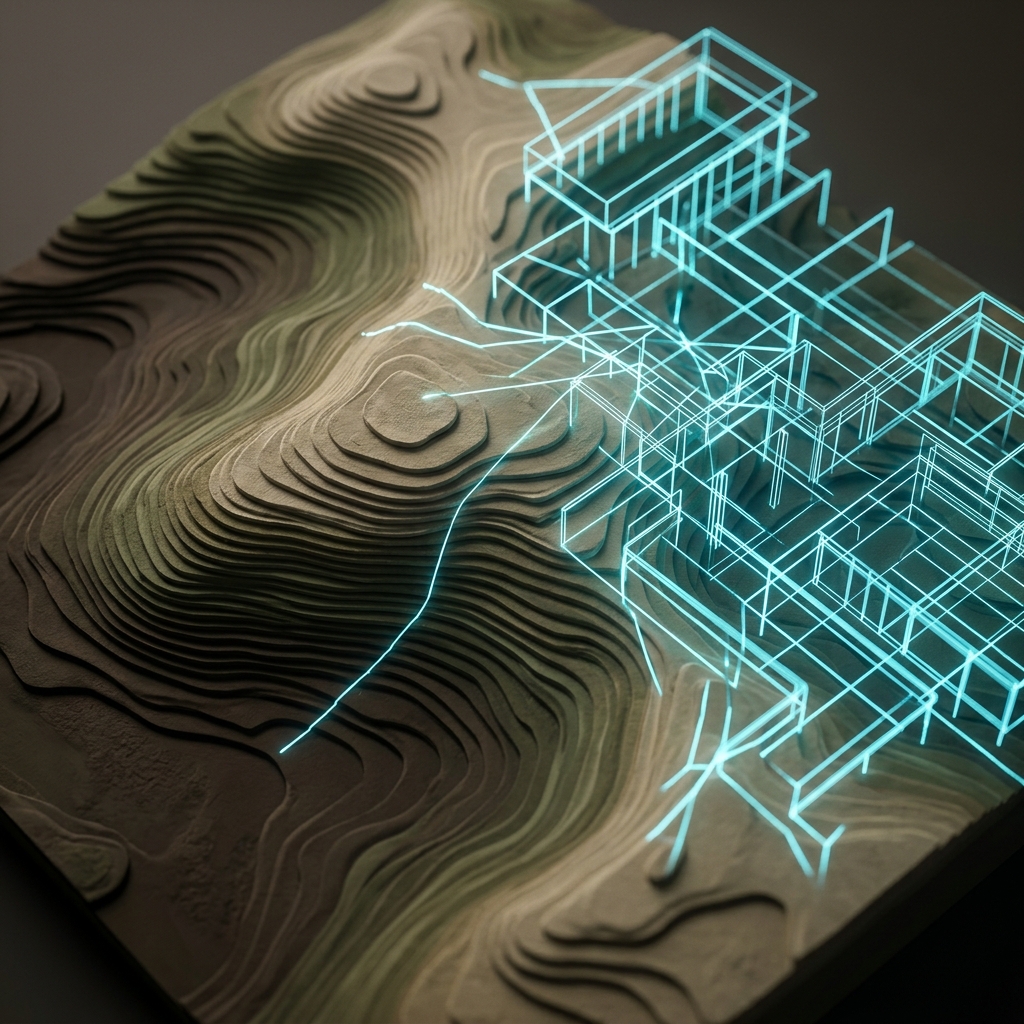
What most alternatives get wrong: they deliver interior wow-factor and leave the operational perimeter invisible. That blind spot is where scheduling and safety plans unravel.
A grounded scenario: the rebrand that fragmented reality across 12 locations
A multi-location hospitality group refreshes its brand and rolls out new signage, new amenities, and new room types across 12 properties. Marketing updates the website. Operations updates binders. Training updates slide decks. None of it agrees.
Now the front desk promises features that aren’t installed yet. Maintenance inherits inconsistent documentation. Guests arrive with expectations shaped by old photos and mismatched descriptions. Conversions dip, refunds rise, and the team blames “seasonality.” It wasn’t seasonality. It was an information architecture failure.
A 3D Virtual Tour or full 3D Digital Twin fixes this only when it becomes the source of truth—the place where hotspots, notes, and updates live in the space itself. Otherwise, you just added one more “version” of reality.
Case study signal: Siemens proves the operational direction, not the gimmick
Siemens has publicly documented how digital twin initiatives support measurable improvements in industrial environments. In Siemens’ own overview of digital twin work, the emphasis is simulation, optimization, and lifecycle decision support—not visualization for its own sake (Siemens: Digital Twin).
That same direction shows up in the strongest outcomes we see in the field: one capture used across departments. A resort team uses a digital twin to reduce pre-arrival uncertainty (fewer “will this work for us?” calls) while ops uses the same model to coordinate vendors and refresh cycles. The model doesn’t just sell the experience. It protects the experience.
And yes—digital twin programs are consistently tied to efficiency gains in the broader market. McKinsey describes digital twins as a lever for operational improvement when they’re built and used as part of the operating system, not as a one-off visualization (McKinsey: Digital twins—how to build the first twin).
Expert context: “living models” only matter if the organization can actually use them
Dr. Michael Grieves—widely credited with formalizing the “digital twin” concept—has emphasized that the value is in the relationship between the physical system and its digital representation over time, not in a static 3D model. NASA’s digital twin work underscores the same trajectory: models that support prediction, understanding, and decision-making (NASA: Digital Twin White Paper (PDF)).
The blunt truth: a “living model” that your team can’t navigate, annotate, and share is just a file on a server. Operational value requires usability—fast loading, intuitive movement, and collaboration features that match how work actually happens.
Where Verge Visions fits: choose the deliverable that matches the job
Not every space needs the same level of operational depth. The decision is about what you need the model to do next week.
Need remote walkthroughs that convert? Start with a 3D Virtual Tour—photorealistic, embeddable, and built for buyer confidence.
Need a source-of-truth replica for operations, safety, and training? Use a 3D Digital Twin with spatial accuracy and collaboration features.
Need full-site context outdoors? Add 3D Drone Aerial Mapping for exteriors and infrastructure.
If you want to see what “as close as being there gets” looks like in practice, explore Verge Visions projects like the Austin 3D Virtual Tour Penthouse or the Porsche 3D Showroom. These aren’t demos. They’re proof that navigation and narrative can coexist without sacrificing spatial trust.
See the structural patterns AI uses to select brands like yours
AI and search don’t reward the flashiest visuals. They reward the clearest, most consistent signals of what something is, where it exists, and how it connects to real-world proof. A spatially trustworthy model with anchored documentation creates that clarity across teams and channels.
Schedule a Free Consultation with Verge Visions and we’ll map the exact decision moments your 3D environment needs to support—then build the capture, navigation, and spatial context that makes those decisions faster. Start by browsing our work, then take the next step: Schedule a Free Consultation.

FAQ
What’s the difference between a 3D virtual tour and a 3D digital twin?
A 3D Virtual Tour is built for photorealistic navigation and presentation—great for remote conversion and stakeholder walkthroughs. A 3D Digital Twin is a spatially accurate replica designed to carry operational workflows (safety tagging, collaboration notes, training, and ongoing updates).
How do 3D virtual tours reduce downtime in facilities?
They reduce downtime by shrinking decision time: teams locate assets faster, validate access routes remotely, and share a single visual reference during incidents. Deloitte highlights downtime reduction and performance improvement as common digital twin outcomes in Industry 4.0 environments (Deloitte’s digital twin analysis).
What should be tagged inside a 3D environment for safety and compliance?
Tag emergency and compliance-critical assets first: AEDs, extinguishers, fire risers, utility shutoffs, hazmat zones, cameras, alarms, and evacuation routes. Verge Visions’ Safety Object Identification anchors these assets at their real locations so audits and incident response don’t depend on tribal knowledge.
Are Gaussian Splatting-based captures more usable than panorama tours?
Yes. Gaussian Splatting produces continuous movement and true spatial depth, which reduces the “jump cut” navigation that makes users distrust orientation in panorama-based tours. Usability is the difference between a model people admire and a model people rely on.
About the Author
Gabriel Thorne is a visual storyteller with a background in filmmaking and photography, focused on building immersive, photorealistic experiences that help teams make decisions without being on-site. At Verge Visions, he translates complex 3D capture and digital twin work into narratives that feel human—because the end user is always a person under time pressure.
Disclaimer: The statements and products discussed in this article have not been evaluated by the Food and Drug Administration (FDA). This content is for informational and educational purposes only and is not intended to diagnose, treat, cure, or prevent any disease. Always consult with a qualified healthcare provider before starting any new supplement, product, or wellness routine.